

Model: Samsung P9 256GB microSD Express Memory Card
Manufacturer: Samsung Electronics
Provided By: Samsung America
Samsung Electronics has been a leader in the electronics industry for more than 30 years. Since the introduction of their first television in 1970, this Korean company has grown to become one of the world's leading electronics manufacturers, offering everything from tiny semiconductors to large home appliances. Samsung is no stranger to the storage industry either. Along with an assortment of DVD and Blu-ray Disc drives, the company offers both hard drive and flash based storage solutions for the portable and desktop computer markets.
It's been a number of years since Samsung launched its current line of SD and microSD cards. Since then, the company has continued to deliver new memory cards with faster speeds and greater capacities. This winter, Samsung introduced its first ever microSD Express card, the P9. Available in 256GB and 512GB capacities, this microSD Express card is designed to deliver next-level gaming experiences on the Nintendo Switch 2. Along with storing all your favorite games and downloadable content, the P9 offers maximum sequential read speeds of up to 800MB/s. The card also features support for Host Memory Buffer (HMB) and Dynamic Thermal Guard (DTG) technologies for smooth, reliable gameplay.

As with Samsung's other memory cards, the P9 has been designed with maximum durability in mind and features the company's six-proof protection. In addition to protection from water, temperature, x-rays and magnets, this microSD Express card is drop and wear-out proof and can withstand up to a five-meter drop as well as up to 10,000 swipes.
Needless to say, this is only a taste of what the P9 has to offer. To give you an idea of what to expect, we'll take a closer look at Samsung's new microSD Express card and then see how well it performs. Does the P9 have what it takes? Keep reading as we find out.
Packaging:
Like most other memory cards, Samsung's P9 microSD Express card comes packaged in a cardboard blister pack. The front of the packaging advertises many of the card's key features including its capacity, class rating and its maximum read speed.
 |
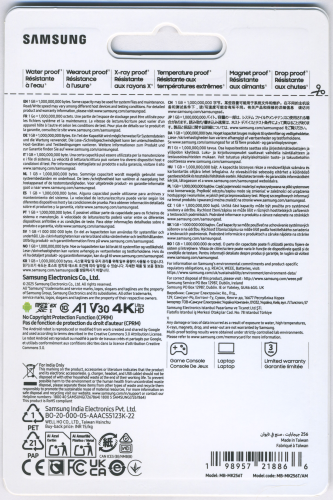 |
The back of the packaging provides a bit more information regarding the features and capabilities of Samsung's P9 microSD Express card. Along with its speed classes and grades, the packaging shows that it is covered by a 3 year warranty and is water, temperature, x-ray, magnet, drop and wearout-proof.
Physical Features:
As you'd expect, Samsung's P9 microSD Express card is quite small. It measures 15 x 11 x 1.1 mm and weighs in at a mere 0.25g. The card is constructed out of white plastic with black and red printing on top of it. Along with the Samsung logo, the card shows the capacity, model and speed class ratings.

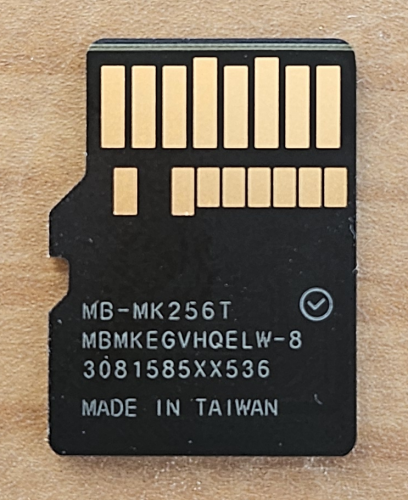
On the back of the card, you can see two rows of pins as well as the model number, production batch and serial numbers and the country of origin. In this case, the P9 is made in Taiwan.

The big difference between microSD Express cards like the P9 and your average, run of the mill microSD card is the second row of pins. This second row offers support for PCIe technology for greater speeds and lower latency. Looking at the screenshot below, you can see that the P9 is recognized as an NVMe storage device with features like S.M.A.R.T. and TRIM.

Performance:
The test system used in this review is equipped with an AMD Ryzen 7 3700x CPU, MSI B550 GAMING PLUS motherboard, 16GB (8GB x 2) of Crucial Ballistix 3200 MHz DDR4 memory, Crucial P5 1TB SSD, GIGABYTE GeForce GTX 1060 WINDFORCE OC 6G graphics card and Lexar Play PRO MicroSD Express and Multi-Card 2-in-1 USB 3.1 card readers. For the operating system, I used the latest version of Windows 11.
To test the performance of Samsung's P9 microSD Express card, I ran a series of benchmarks using CrystalDiskMark, ATTO Disk Benchmark and PCMark 10. To get a feel for the "real world" performance, I also copied and pasted 1GB of random files and directories as well as a single 4GB ISO file in Windows Explorer.
CrystalDiskMark 9.0.1:
First, I ran a few quick tests using CrystalDiskMark. This benchmark measures the performance of a storage device by testing its sequential and random read and write speeds. For this test, we're using the peak and real world profiles.

According to Samsung, the P9 is capable of reading at 800 MB/s. As you can see, the drive had no problems reaching this speed in CrystalDiskMark's sequential read test. More impressive though was its random read and write performance. With a single thread and a queue depth of 32, the card reached 42,480 random read IOPS and 54,488 random write IOPS.

As you'd expect, the P9 wasn't as fast when tested with the "real world" profile which uses a much lower queue depth. Nevertheless, it was still able to read at 642 MB/s and write at more than 253 MB/s.

I also tested the P9 to see how well it worked with devices that don't support the microSD Express standard. When inserted into the Lexar Multi-Card 2-in-1 USB 3.1 card reader, the card's sequential read and write speeds peaked at about 88 MB/s.
ATTO Disk Benchmark 4.01:
I also used ATTO Disk Benchmark to test the P9 microSD Express card's sequential read and write speeds. The tests are run using blocks ranging in size from 512B to 64 MB and the total length set to 256MB.
 Samsung P9 microSD Express SD Express |
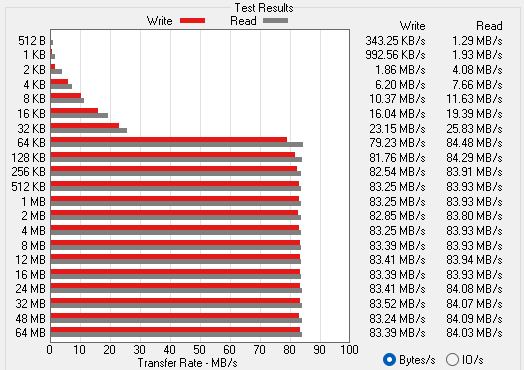 Samsung P9 microSD Express UHS-I |
When tested with ATTO, the P9 microSD Express card's read speeds topped out at about 800 MB/s and its write speeds at 223.25 MB/s.
PCMark 10 - Data Drive Benchmark:
PCMark 10's Data Drive Benchmark is designed to test drives that are used for storing files rather than applications. You can also use this test with NAS drives, USB sticks, memory cards, and other external storage devices. This benchmark produces an overall score as a measure of drive performance. Comparing devices is as simple as comparing scores. The tests also measure and report the bandwidth and average access time for the drive.

"Real World" Benchmark:
To test the "real world" performance of Samsung's P9 microSD Express memory card, I copied and pasted 1GB worth of randomly generated files and directories. All of the files are between 1KB and 95MB in size and no more than five directories deep. To see how well the cards handled large files, I also copied and pasted a 4GB ISO file.
| Samsung P9 microSD Express SD Express |
Samsung P9 microSD Express UHS-I |
|
| 1GB Files - Write: | 7 seconds | 18 seconds |
| 1GB Files - Read: | 3 seconds | 14 seconds |
| 4GB ISO File - Write: | 20 seconds | 51 seconds |
| 4GB ISO File - Read: | 6 seconds | 49 seconds |
Samsung's new card performed very well here, taking 7 seconds to write 1GB worth of test data and a mere 3 seconds to read it back.
Final Thoughts:
With the introduction of the Nintendo Switch 2, SD Express technology is finally seeing mainstream adoption. Seemingly overnight, the retail market exploded with microSD Express memory cards from a variety of manufacturers. Samsung has now thrown their hat into the ring with the P9. In addition to SSD-level performance and enough storage for all of your favorite games, the card offers many of the same features and reliability that we've come from the company's other microSD and SD cards.
When it came time to perform, the P9 didn't disappoint. Thanks to support for Host Memory Buffer (HMB) technology, the 256GB card was able to read at speeds as high as 838 MB/s and write at more than 240 MB/s when plugged into an SD Express compatible reader. The P9's random read and write performance was also quite impressive. Even at low queue depths, its was more than twice as fast as conventional UHS-I memory cards and had considerably lower latency. The only area where the P9's performance suffered a bit was when it was plugged into an older device and was forced to use its UHS-I interface. Nevertheless, its more than adequate if you need to occasionally transfer data between your gaming console and computer.
Samsung's P9 microSD Express card is available now in 256GB and 512GB capacities and can be purchased through retailers like Amazon for $55 and $120, respectively.