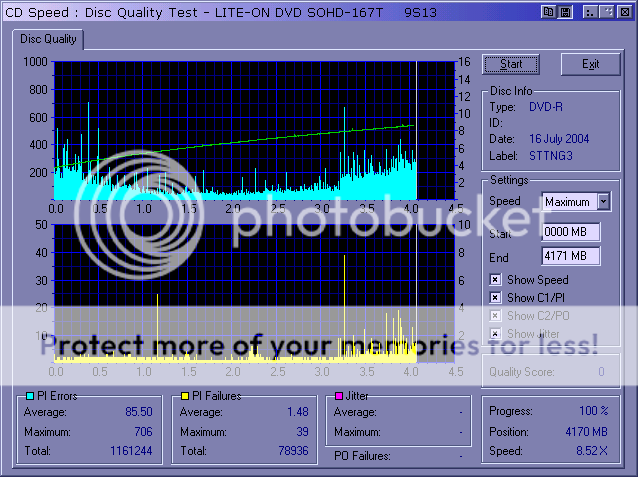
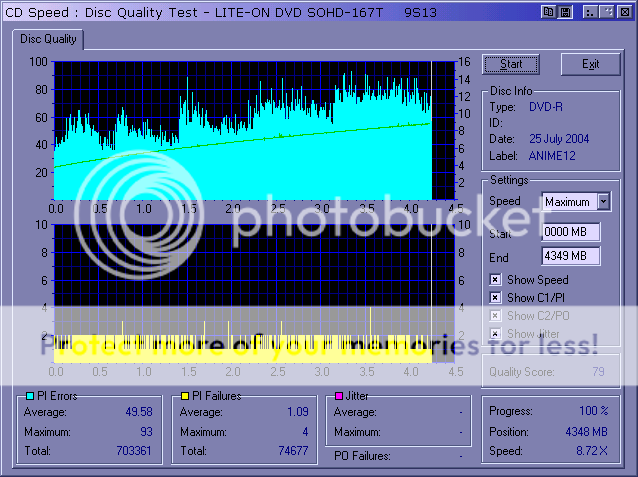
Because if it's accurate I have a problem. I scanned some of the discs I made on my LG 4082b with one and it reported 10's of thousands of PIF errors with both Maxell and Ritek media.
EDIT: corrected spelling mistake.
 |
 |
 |
 |
 |
 |
 |
 |
 |
 |
|
||||||||
|
 by Gooberslot on Mon Jul 26, 2004 8:41 am
by Kennyshin on Mon Jul 26, 2004 9:27 am
by Halc on Mon Jul 26, 2004 10:03 am

by dolphinius_rex on Mon Jul 26, 2004 10:39 am

by Gooberslot on Mon Jul 26, 2004 12:25 pm
by thegdog on Mon Jul 26, 2004 2:05 pm
Gooberslot wrote:I read that thread on CDRInfo and decided to run a test using CDSpeed like they did. Not too good at all. Much worse than what Kprobe2 reported.
by rdgrimes on Mon Jul 26, 2004 4:23 pm
by Kennyshin on Mon Jul 26, 2004 5:26 pm
dolphinius_rex wrote:...
Using multiple drives to test the same disc, is the best way to gain any kind of a real opinion of the disc's quality and compatability. Sadly this is very time consuming!

by dolphinius_rex on Mon Jul 26, 2004 7:06 pm
by rdgrimes on Mon Jul 26, 2004 7:39 pm
There is *NO* accurate way of testing DVDRs with consumer drives
by dolphinius_rex on Mon Jul 26, 2004 8:19 pm
rdgrimes wrote:The point of PI/PIF scanning is not to determine absolute "quality" of a burned disc, but simply to compare it to a "benchmark" of previous scans on the same drive (under the same conditions) to see if it's better or worse than another disc. It's really very simple, but it seems that some people want to complicate it.
rdgrimes wrote:How a particular LiteOn drive compares to some reference equipment is totally irrelevant for most purposes. It couldn't matter less. What matters is that end users have SOME way of comparing relative read-ability of their burns, so they don't lose data or create discs that won't play. To that end, the tools at hand are totally adequate. To suggest that they not waste their time scanning is , well, just irresponsible.
by rdgrimes on Mon Jul 26, 2004 8:59 pm
by dolphinius_rex on Mon Jul 26, 2004 10:33 pm
It makes no difference to me what-so-ever whether that same media that performs well here will also perform well in another burner. In fact I wouldn't expect it to in every case. The notion that you can PREDICT how a media type will perform in my drive, based on standardized tests is what is obsurd, because you can't and never will. Burners are all diffferent, even "identical" drives of the same model. Media is all different, even "identical" media.
There will never be any such thing as "absolut value", nor would a reasonable and informed person expect there to be. Nor would an informed person expect to compare scans done at different speeds or from different drives. That includes standardized test equipment too, the results attained on such equipment will in no way predict what consumer drives will do.
by rdgrimes on Tue Jul 27, 2004 12:38 am
by code65536 on Tue Jul 27, 2004 1:08 am
dolphinius_rex wrote:I am getting so sick of all the BS out there regarding DVD testing. Honestly! There is *NO* accurate way of testing DVDRs with consumer drives, and that's all there really is to it. You can have approximations of accuracy when you have drives cross referenced with real testing equipment, like what CDRinfo did.


by dolphinius_rex on Tue Jul 27, 2004 2:04 pm
code65536 wrote:And if I may be so blunt, people hold CATS up like some infallable holy grail is sickening, too.
code65536 wrote:What does it matter what a CATS device tells you? The devices that people are going to use to read back these discs are not CATS machines. What CATS will tell you is very simple: it tells you how other overpriced CATS machines will read the disc. Great, so you can safely and accurately compare your CATS scan with someone else's CATS scan on the other side of the world, because all CATS scanners are nicely calibrated, etc. But what good does that do the end-user? Besides the fact that such machines are prohibitively expensive. Besides the fact that doing these "proper" tests are extremely time-consuming. The alternative is to use a heuristic. One that works fairly well, I might add.
code65536 wrote:The point here is that, for practical considerations, there is a heuristic that's being used. It's not BS because people are instructed to take it all with a bit of a grain of salt--comparing it with your own scans from the past, and then interpreting what the KProbes mean by crossreferencing the results you get with what kind of performance you experience when testing on other devices like standalones. And it just so happens that this heuristic is stable enough that, in a number of cases (though certainly not all), it is reasonable to compare scans from drive A to drive B. Heck, when scanning the same disc, my 832S and my 3S produces identical results, within 10% of each other. Direct comparison is something that, on the surface, we say, "no, this doesn't really mean much", but the heuristic is good enough that it allows people to, under what limited time and resources people have, try to do something meaningful with it.
code65536 wrote:As rd said, the alternative is to do nothing or to watch the people who could afford CATS do their hocus-pocus.
code65536 wrote:PS: The whole reason I'm on an anti-CATS crusade is that after seeing so many people cling onto the precious C't results like they were the word of some deity because they were performed with... *gasp* CATS! I can't begin to count the number of people who took the results of a CATS scan from one individual variable drive unit taken from one individual variable batch of drives taken from one individal variable factory using one disc from a spindle of discs that may very well have intra-spindle variation coming from a batch that may very well vary from other batches and coming from a media factory that may very well vary from other media factories, burned under very unique conditions (system setup, drive temperatures, phase of the moon, etc.) as something that was absolutely indicative of the performance of that drive in general with that media in general in all situations (yes, it's better than looking at Joe Sixpack's KProbe and making an overbroad conclusion). The point is, things vary, and that's why everyone should be doing some testing of their own, and to then dismiss self-testing as worthless because it's not some vaunted CATS is counter-productive. So is relying on someone else's results just because that someone else used the high-and-mighty CATS.
 This isn't the reviewer's fault of course, just a problem inherent in the system as it is right now.
 code65536 wrote:My apologies if I sound harsh. But over the past few months, the obsession with this non-existant holy grail of testing has put me in a sour mood.
 I'm just pretty pissed off myself over the use, and abuse of K-Probe (and other) tests for the last while, and the apparent choice of convenience over professionalism in the industry.
Users browsing this forum: No registered users and 3 guests
| All Content is Copyright (c) 2001-2026 CDRLabs Inc. |