

- Details
- Flash Memory
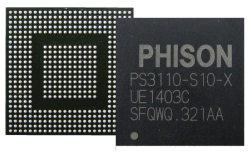 Phison Electronics Corporation, a global leader in SSD controllers, today announced its latest quad-core SATA III 6Gb/s SSD controller, the PS3110 SSD processor. PS3110 is a performance power house, delicately crafted to support not only the high-end client SSD market, but also includes multiple hardware and firmware features to make it an ideal choice for the entry-level enterprise SSD solutions supporting up to 2 Terabyte.
The building blocks of PS3110 include a quad-core CPU, end-to-end data path protection circuits, and SmartECC™ technology to provide additional error bit correction while supporting the latest generation 1Ynm/1Znm MLC and TLC NAND.
Working with today’s 1Ynm MLC, PS3110 delivers up to 550MB/s sequential read and 530MB/s sequential write performance, with random 4K IOPS up 100,000 read and 90,000 write. With the additional AES-256 engine and P-fail feature options, PS3110 is able to offer a comprehensive product line across client, industrial, entry-level enterprise, and data center SSD solutions.
- Details
- Flash Memory
Plextor, a leading developer of digital storage technology, is pleased to announce that their Plextor M6e PCIe SSD has won Best of Show for most Innovative Flash Memory Technology at the Flash Memory Summit in Santa Clara, California. The FMS Best of Show Awards is a premier venue for industry recognition of innovative products.

The tiny but powerful M6e PCIe fits into a PC motherboard's M.2 slot without need of a power or data cable. Most notably, this Solid State Drive brings small form factors—or NGFF (Next Generation Form Factor)—into the performance picture while at the same time providing greater bandwidth and incredible speed. PCI express handily bypasses the SATA speed bottleneck to significantly improve performance for extreme users and elite gamers. Impressive numbers tell the story: maximum sequential read/write speeds of 770/625 MB/s and random read/write speeds of 105/100K IOPS.
- Details
- Flash Memory
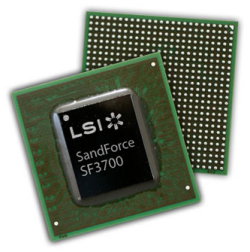 LSI, an Avago Technologies Company, today announced breakthrough performance and endurance demonstrations of its third-generation SandForce SF3700 flash controller. After successfully introducing industry-leading sequential performance of 1800MB/s, the SF3700 is now demonstrating mixed 80/20 (read/write) workload performance of up to 1300MB/s with a native PCIe interface. This incredible real-world performance is supported by the integrated SHIELDTM error correction with hard and soft LDPC and DSP technology, engineered to meet the associated endurance requirements.
The SF3700 performance and endurance represents a substantial improvement over competitive flash controller designs. Unlike current solutions, the SF3700 controller is optimized and architected for bi-directional PCIe traffic, unlocking the maximum performance capability to meet requirements for client and enterprise applications.
“Flash storage solutions used for client computing, big data, and hyperscale enterprises are continuing to grow at unprecedented levels, driving the need for more advanced flash controllers to manage these data-intensive environments,” said Thad Omura, vice president of marketing, Flash Components Division, LSI. “The SF3700 is the ideal-building block for next-generation storage solutions with its full-duplex architecture. Both enterprise and client applications will benefit from our proprietary LDPC engine which enables customers to significantly extend NAND flash life by dynamically balancing performance and reliability with minimal latency.”
- Details
- Flash Memory
 Samsung Electronics Co., Ltd. announced today that it has begun mass producing a new, high-performance SAS-interface solid state drive (SSD) using 10-nanometer (nm) class MLC NAND flash memory.
“With our new SAS SSD, our competitiveness in the enterprise storage SSD market has been strengthened,” said Jeeho Baek, vice president, memory marketing, Samsung Electronics. “We are committed to providing storage customers with an exceptionally wide variety of next-generation, high-capacity SSDs in driving the fast-growing enterprise storage SSD market.”
The new Samsung SAS SSD – SM1623 – is designed to meet the immediate need of many global customers for cost-effective, high-capacity SSDs. With this release, Samsung has bolstered its SAS (Serial Attached SCSI) SSD line-up targeted at enterprise customers. Samsung’s extensive SSD portfolio for the enterprise market covers all available major interfaces, ranging from NVMe (Non-Volatile Memory express) to PCIe (Peripheral Component Interconnect express), and SATA (Serial Advanced Technology Attachment), as well as serial attached SCSI (SAS).
- Details
- Flash Memory
Plextor, leading developer of digital storage technology, has launched its new M6 PRO SATA SSD. The M6 PRO combines fast and stable Plextor hardware with intelligent RAM caching utility called PlexTurbo. First previewed at Computex 2014, the M6 PRO with PlexTurbo set a new standard for SATA SSDs.

PlexTurbo is intelligent utility that uses some of the system RAM as an ultra-smart RAM cache, bypassing limitations of the 6 Gb/s SATA III channel and delivering additional speed for real-world applications. In addition to outperforming competing technology, PlexTurbo minimizes RAM usage, uses active data comparisons to prevent unnecessary writes, and prevents RAM cache data loss if power is interrupted.
The M6 PRO’s hardware uses a new generation of A19 nm Toshiba toggle NAND flash and a multi-core Marvell controller with Plextor’s in-house developed firmware. The M6 PRO has a new ultra-low-power and fast-resume DEVSLP mode that gives longer battery life to notebooks and reduces wasted power in desktop systems while retaining responsiveness. The M6 PRO features the latest version of Plextor’s acclaimed long-term performance-sustaining True Speed technology. Also included is Plextor's True Protect system, with multilayer data integrity and security provided by 256-bit AES full-drive encryption.


