

- Details
- Flash Memory
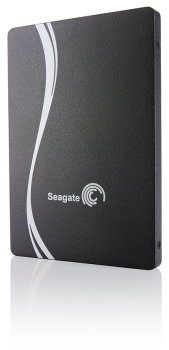 Seagate Technology plc, a worldwide leader in storage solutions, today announced its new portfolio of flash-memory solutions. The company took the wraps off its first client solid state drive (SSD) and its next-generation enterprise SSDs. Featuring the Seagate 600 SSD, Seagate 600 Pro SSD, and the Seagate 1200 SSD, the new line of drives are engineered to deliver ultra-fast speed and high data integrity. Rounding out the portfolio, Seagate also announced the new Seagate X8 Accelerator, a storage class memory PCIe card powered by Virident enabling the company to offer all key interfaces including SATA and SAS solutions.
“We are pleased to announce these new flash memory products. With these new drives, Seagate solidifies its commitment to the flash-based storage market by delivering enterprise SSDs and server-side solutions as well as client solutions,” said Gary Gentry, senior vice president and general manager of Seagate’s solid state drive business. “By adding more SSDs to our family of hard disk and solid state hybrid drives, we now have the broadest portfolio of storage products in the industry, delivering one-stop shopping for our customers and partners. And we’re just getting started. Seagate is committed to becoming a premier supplier of both solid state drives and storage class memory products. We have put in place a winning strategy for developing multiple high value, flash based products and solutions for our customers.”
Seagate 600 SSD: Faster Performance with 6Gb/s SATA
The ultimate laptop upgrade, the Seagate 600 SSD delivers faster boot up speeds, shorter application load times, and improved system responsiveness for the ultimate performance. Laptop users can boot up nearly four times faster and load applications more than two times faster than with a standard hard drive, greatly reducing the amount of wait time to access content.
- Details
- Flash Memory
Mimoco, makers of the MIMOBOT line of designer USB flash drives, in collaboration with Lucasfilm and in honor of the Star Wars fan favorite holiday May the Fourth Be With You, announce the R2-A6 MIMOBOT. R2-A6, an astromech droid in the same family as R2-D2, is translated in the MIMOBOT’s stylistically illustrated flash drive form. Available in up to 128GB and USB 3.0 capabilities, the drive comes in a run of 1,000 limited edition hand-numbered units. The R2-A6 MIMOBOT drive also comes preloaded with bonus Mimory and the MimoDesk personalization suite of wallpapers, icons, and avatars.
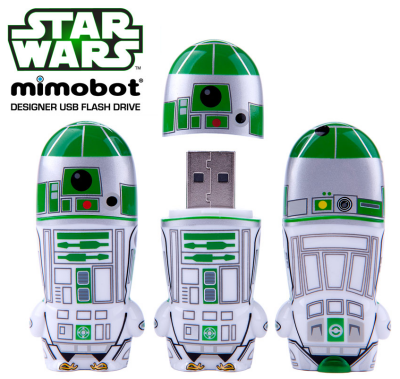
R2-A6 is known as a good-luck charm to the Royal Naboo Security Forces and now, in MIMOBOT form and function, can be a positive omen for your data storage. The droid’s green and white color scheme is derivative in design and function of fellow mechanically-versed droid, R2-D2. Just as a proper astromech droid would be expected to perform, R2-A6 MIMOBOT allows documents, music, photos, and data to be shared, transported, and collected for its master. Just don’t expect it to repair a starfighter malfunction in our earthbound orbit!
- Details
- Flash Memory
Micron Technology, Inc. today announced a new PCIe all-flash I/O accelerator to improve overall performance in enterprise servers, appliances and storage platforms. The new Micron P420m combines consistent performance with the inherent power efficiency of an all-flash system to deliver improved economics for enterprise data centers. The P420m accelerates performance of today's demanding data center applications, including online transaction processing (OLTP), data warehousing and virtualization.
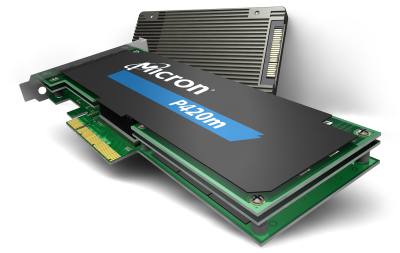
Ultimately, Micron's P420m ends the wait game for digital data. It features ultra-low latency performance that enables fast and predictable response times to information frequently used in data center environments. When tested against competing PCIe solutions in a MySQL server running an OLTP benchmark, the P420m is the fastest and most consistent performer, delivering more than 3,200 web server requests per second. It handily manages online requests during peak traffic times, improving the overall end-user experience.
- Details
- Flash Memory
Corsair, a worldwide designer and supplier of high-performance components, today announced two new solid-state drive (SSD) related products. The first, the SSD & Hard Disk Drive Cloning Kit, enables users to easily duplicate and transfer data between drives. The kit, which includes a cable and software, is ideal for users upgrading from traditional hard disk drives (HDD) to faster, more rugged Corsair SSDs. In addition, the company announced the Corsair SSD Toolbox, a free software utility which enables users to configure, optimize and monitor their Corsair SSDs.
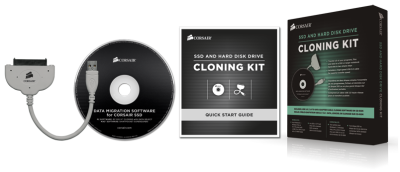
The SSD & Hard Disk Drive Cloning Kit enables users to move data between a hard drive and SSD by simply selecting the source drive and destination drives and then clicking a button. Designed for users migrating their data to newly installed SSDs, the kit includes data migration software, a USB-to-SATA cable, and Quick Start Guide. The cable supports USB 3.0 and 2.0 delivering transfer rates up to 180MB/s with USB 3.0 ports, 4 times faster than USB 2.0.
- Details
- Flash Memory
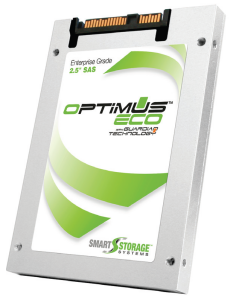 SMART Storage Systems, an innovative enterprise solid-state drive (SSD) technology provider, today announced the new Optimus Eco, the first Serial Attached SCSI (SAS) 6Gb/s SSD on the market to leverage 19nm multi-level cell (MLC) Flash. Continuing the company's effort to usher in a new era of Flash storage, and anticipating the changing needs of enterprise data centers, SMART Storage Systems' new Optimus Eco SSD represents the industry's best combination of performance, capacity, endurance and cost in an enterprise-class 2.5-inch drive.
Forced to do more with less, many organizations are choosing to build their own hyperscale architectures by combining best-in-class hardware and software to lower costs and meet growing data center demands. In addition, looking to control maintenance costs, data center managers are seeking the highest-capacity drives to pack more capacity into a rack, resulting in the ability to reduce their storage footprint. In fact, Gartner estimates that in 2016 the average capacity of an SSD deployed in enterprise storage and server environments will be more than 1.1TB1. When combined with SSDs that can provide the endurance necessary to support write-intensive applications with cost-effective 19nm MLC Flash, the result is a dramatic reduction in storage total cost of ownership (TCO).


