

- Details
- Flash Memory
Toshiba America Electronic Components (TAEC) is introducing 32nm double data rate Toggle Mode NAND, in multi-level cell (MLC) versions with densities of 64Gb, 128Gb and 256Gb and single-level cell (SLC) versions with densities of 32Gb, 64Gb and 128Gb. Toggle Mode NAND features a faster interface than conventional or "legacy" asynchronous NAND memory with lower power consumption than competing synchronous DDR NAND product offerings.
Toshiba DDR Toggle Mode 1.0 NAND has a fast interface rated at 133 megatransfers/second (MT/s), compared to 40MT/s for legacy SLC single data rate NAND, which makes it suitable for high performance solid state storage applications including enterprise storage. Since it uses an asynchronous interface similar to that used in conventional NAND, the Toshiba DDR Toggle Mode NAND requires no clock signal, which means that it uses less power and has a simpler system design compared to competing synchronous NAND alternatives. The DDR interface in Toggle Mode NAND uses a Bidirectional DQS to generate input/output signals (I/Os) using the rising and falling edge of the write erase signal. Toggle Mode NAND also has on-die termination to help achieve less crosstalk.
- Details
- Flash Memory
Micron Technology today introduced the RealSSD P300 solid-state drive (SSD), bringing faster system performance and improved data integrity to enterprise environments. The RealSSD P300 drive features the SATA 6-gigabits per second (Gbps) interface, a first for the enterprise SSD market. The new P300 SSD delivers extraordinarily high steady-state input/output operations per second (IOPS), up to 44,000 reads and 16,000 writes--more than 15 times the write performance of competing SATA-based SSDs.
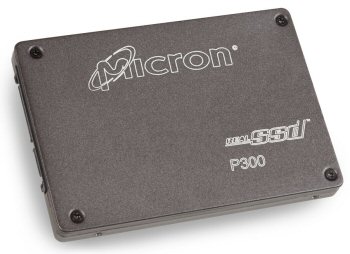
"The RealSSD P300 SSD is the fastest SATA-based drive on the market," said Dean Klein, Micron vice president of Memory System Development. "The RealSSD P300 is able to do the work of multiple hard drives--outperforming a RAID of 12 hard drives in some cases."
The ever-expanding workload of today's enterprise environments requires the technology within to be able to withstand the rigors of data being constantly accessed, transferred and stored. The RealSSD P300 drive was designed specifically to address these requirements by using Micron's high-performance and high-endurance ONFI 2.1 34-nanometer (nm) single-level cell (SLC) NAND technology, ensuring product longevity and added reliability in today's demanding enterprise environments. Combining Micron's high-quality NAND and proprietary firmware design enables the P300 SSD to deliver the highest SATA drive endurance capability in the industry--3.5 petabytes total bytes written for the 200GB drive which is equal to writing approximately 1.9 terabytes per day, every day for five years.
- Details
- Flash Memory
Hynix Semiconductor Inc. today announced that it has begun mass producing 64 Gigabit (‘Gb’) NAND Flash using 20nm class technology at its 300mm Fabrication, M11 in Cheo ngju site. The company developed this cutting edge technology last February.
Hynix’s 20nm class 64Gb chip doubles the density in a package over the current 32Gb product. 20nm class process technology also provides a 60% increase in productivity over Hynix's existing 30nm class technology. By providing these high density and cost efficient chips, Hynix will respond to the needs of advanced mobile solutions which require smaller size and higher density storage capacity.
The company said it has also developed NAND Flash solution products which combine Hynix’s 30nm class 32Gb Flash chips and controller devices from Anobit, an Israeli NAND-based solution provider, through a strategic alliance between the two companies. This solution product operates at a high speed and significantly improves the reliability as a storage device. The newly mass-produced 20nm class NAND Flash chips will also be combined with the controller device and will be validated in September 2010.
- Details
- Flash Memory
MXI Security, the leader in superior managed portable security solutions, now offers a 64GB capacity device for its Stealth line of secure USB devices. The new 64GB versions of the Stealth M-Series and Stealth MXP Bio add this industry-leading memory capacity to their already unsurpassed protection of data, applications, and network access.

MXI Security’s new 64GB devices are also ideally suited ideally for government customers that require high-capacity devices for Secure USB Desktop (SUDs) such as Stealth ZONE™Microsoft Windows Embedded Standard Edition – the secure portable desktop that allows you to natively boot Microsoft Windows from a Stealth USB device.
The 64GB devices are powered by Bluefly™ - the world’s first security processor for USB devices. The device features AES 256-bit hardware encryption, up to 3-factor authentication (i.e. combinations of password, biometric, and/or CAC/PIV cards) and advanced manageability and identity capabilities such as device recycling, key generation, and digital signatures. The entire Stealth product family is FIPS 140-2 Level 3 validated.
- Details
- Flash Memory
Active Media Products, a leading manufacturer of SSDs, DOMs and USB drives, today announced two new 7-pin SATA DOM (Disk on Module) drives featuring a right angle SATA connector for mounting parallel to the motherboard in low-profile enclosures. The new Type-4 and Type-5 SATA DOMs are built with an SMI SSD controller and MLC NAND flash that deliver sequential read speeds up to 90MB/sec and write speeds up to 50MB/sec.

"With the addition of the Type-4 and Type-5 modules we now have a complete selection of SATA DOMs in capacities from 8GB to 32GB, including vertical and low-profile mounting, 7-pin and 22-pin SATA headers, and right and left offsets to fit in virtually any server or embedded application," said Active Media Products VP of Sales, Jerry Thomson. "We accomplished this with just three PCB designs, as the Type-1 and 2 use the same PCB, just with different connector positioning that offsets the module in a different direction. We used a similar 2-in-1 design for the Type-4 and 5 DOMs, so we have less validation work and greater flexibility in responding to OEM requirements."


