

- Details
- Flash Memory
SanDisk Corporation today announced that it has begun shipping its next-generation flash memory-based solid state drives (SSD) for netbooks, offering high-performance components at a competitive price. SanDisk® pSSD™ P2 and S2 employ a new technology called nCache™, which improves netbook performance. The drives will be demonstrated at the SanDisk booth at Computex, Taipei, June 2-6, 2009: Booth # N709 Nangang Hall, 4th floor.
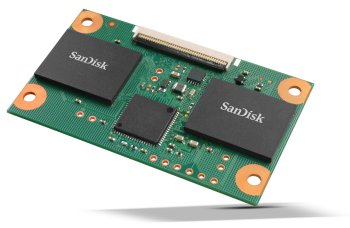
Netbooks are small, low-cost computers that offer consumers a highly portable means of surfing the Internet, accessing email as well as enjoying their favorite music and videos on the go. Market researchers, IDC, project consumer purchases of netbooks to rise from 11.5 million sold in 2008 to 50 million in 2013.
Add a comment- Details
- Flash Memory
Super Talent Technology, a leading manufacturer of Flash storage solutions and DRAM memory modules, made their fifth significant announcement of the week, adding to the broadest SSD portfolio in the industry by introducing the world’s fastest upgrade SSDs for the ASUS® Eee PC™ 900, 901, 901A, 901 GO, and S101 netbook PCs.
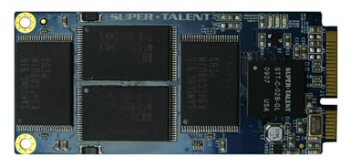
The SATA Mini 2 PCIe SSDs are Super Talent’s second generation product focused on enabling better performance for ASUS Eee PC users and feature a SATA-II (3Gbps) interface.
The products are available with both MLC and SLC flash memory. The MLC version delivers sequential read speeds up to 150 MB/s and sequential write speeds up to 100MB/s, and is available in 16GB, 32GB, and 64GB capacities at very affordable prices.
- Details
- Flash Memory
Silicon Power, the leading brand among Solid State Disk (SSD) Manufacturers lifts the benchmark another notch with their new Portable eSATA/USB SSD II. It is the world’s first eSATA (eSATA; External Serial ATA) /USB dual interface portable SSD drive. The new drive emphasis the convenience of USB connection and the ultra fast performance of eSATA interface as an external drive. Overall, the drive has excellent aesthetics and the performance to match.

Having won rave reviews with their 64GB eSATA /USB SSD, Silicon Power releases the new lidless and portable eSATA/USB SSD II. Through the eSATA interface, maximum read speed reaches 90MB/Sec and maximum write reaches 50 MB/Sec. Maximum read through the USB connection is rated at 30MB/Sec and 20MB/sec for write. It is the perfect solution for professional multimedia enthusiasts or users that often carry and transfer large capacity files.
Add a comment- Details
- Flash Memory
Super Talent Technology, a leading manufacturer of Flash storage solutions and DRAM memory modules, announced it is now shipping new families of PATA/IDE 2.5” SSDs featuring both MLC and SLC Flash and nearly tripling previous performance specifications.
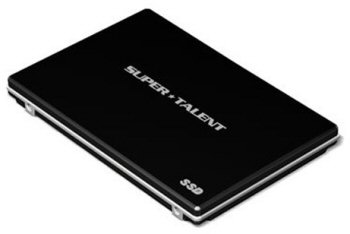
The MasterDrive EX2 is available with capacities from 16GB to 128GB, features sequential read speeds up to 80 MB/s and sequential write speeds up to 40MB/s, and uses MLC flash. It also comes with a 2 year factory warranty.
The MasterDrive IX2 is available with capacities from 16GB to 64GB, enables sequential read speeds up to 80 MB/s and sequential write speeds up to 60MB/s, and uses SLC flash. It also comes with a 3 year factory warranty.
- Details
- Flash Memory
Super Talent Technology, a leading manufacturer of Flash storage solutions and DRAM memory modules, announced it is introducing the PCIe RAIDDrive Workstation. These Workstations uses Super Talent’s patented RAIDSSD™ Technology to accelerate the adoption of systems with very high performance solid state disk subsystems through the integration of large amounts of SSDs. The PCIe RAIDDrive Workstations are based on Intel’s newest Quad-Core Core I7 Processors, and Super Talent’s 1333MHz DDR3 DIMMs.
The PCIe RAIDDrive Workstations scale up 6TB in a Workstation Tower form factor. Benchmarking data taken with Crystal Disk Mark v2.2 shows sustained sequential read speed of over 1.5 GB/sec (1500 MB/sec), sequential write speed of nearly 1.35 GB/sec (1350 MB/sec). Benchmarking data taken with HDBench showed random read speed of 725 MB/sec and random write speed of 515 MB/sec.


