

- Details
- Network Storage
Buffalo Technology, a global leader in the design, development and manufacturing of wired and wireless networking and network and direct attached storage solutions, today announced the TeraStation 7120r and TeraStation 7120r Enterprise, the first in a series of ultra high performance, 12-bay 2U rack mountable NAS and iSCSI storage servers packed with business-class features and advanced functionality. These newest network storage solutions make up the TeraStation 7000 series, the latest storage server family featuring powerful Intel® Xeon® quad core processors, upgradeable DDR3 RAM and configurations that include enterprise-class hard drives, ideal for businesses in need of a cost-effective, scalable RAID-based network storage solution for large networks and business critical applications.
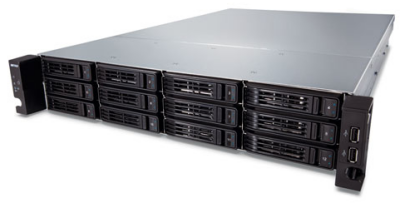
The new TeraStation 7120r Enterprise TS-2RZHD offers 24 TB of high performance, scalable storage featuring the powerful Intel Xeon E3-1275 quad core processor, 8 GB of DDR3 RAM and 12-2 TB enterprise-class hard drives. TeraStation 7120r Enterprise provides exceptional performance and runs many services simultaneously. The quad core processor enables the ability to focus on concurrent tasks with minimal performance degradation: experience maximum network throughput while replication and backup jobs run in the background. TeraStation 7120r Enterprise is packed with business-class features such as Active Directory support, disk quota support, share level replication, quad gigabit Ethernet ports supporting link aggregation up to 4 Gbps, hot-swap hard drives, iSCSI targeting and add-on PCI-Express card support with approved devices.
- Details
- Network Storage
Synology Inc. today released the Mac client of Cloud Station Beta, providing an easy, yet secure data synchronization solution for Mac users.
“Cloud Station redefines the role of a NAS server, making Synology DiskStation and RackStation a true private cloud which not only pushes your data to all your devices automatically, but also keeps them up-to-date,” said Darren Lin, Product Manager of Synology Inc. “Cloud Station can grow with users’ demands with no recurring fees. It is one of users’ favorite features in DSM 4.0, and we are excited to bring it to Mac users.”
Cloud Station syncs and backs up users’ content seamlessly across their PCs, Macs, and DiskStation or RackStation. On an offline computer users can still view and edit files, and the changes will be synchronized to other computers when Internet connection resumes. Cloud Station provides users with extra peace of mind by saving the previous versions of their files for easy data restoration. In addition, Cloud Station is a convenient way for business to boost office productivity. Account users can own their particular Cloud Station folders, or share a Cloud Station folder to collaborate on a project.
- Details
- Network Storage
Today LaCie announced a new 2-bay network-attached storage solution (NAS) that delivers the ideal combination of speed and security for small businesses – the LaCie 2big NAS, design by Neil Poulton. Powered by a 2GHz processor and improved file system, the 2big NAS delivers speeds up to 100MB/s, ensuring employees can share files from any PC, Mac, or Linux workstation.
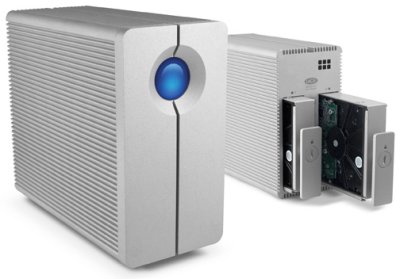
"According to data from Research and Markets, network storage is growing in excess of 30% annually, increasing the demands placed on network storage devices," said Erwan Girard, Professional Business Unit Manager at LaCie. "The LaCie 2big NAS was developed to scale with the needs of SOHO users, delivering fast file sharing and data security, the two most critical factors for a small business."
- Details
- Network Storage
Iomega, an EMC company and a global leader in data protection, today announced the new Iomega StorCenter px12-450r Network Storage Array, multi-protocol networked data storage for small and medium business, remote office/branch office installations and distributed enterprises. The StorCenter px12-450r features the new Intel Xeon Processor E3-1200 v2 Product Family, 8GB RAM, improved user supportability and is ready for 4TB hard disk drives (HDD) and 10 gigabit Ethernet (10GbE) networks. Additionally, the StorCenter px12-450r utilizes the latest version the EMC® LifeLine™ software, an advanced operating system that makes EMC’s enterprise class expertise and cloud capabilities available to a broad range of users.

The new StorCenter px12-450r Network Storage Array is designed for advanced functions including dedupe, VDI, database and storage-based applications. Examples of emerging applications include video management systems (VMS) for surveillance and McAfee VirusScan Enterprise running natively on the storage.
- Details
- Network Storage
QNAP Systems, Inc. today announced its new additions for the high-end SMB market segment with two 16-drive 3U rackmount Turbo NAS models with up to 64TB storage capacity using 4 TB drives. The TS-EC1679U-RP and TS-1679U-RP, powered by the Intel® Xeon® processor and the Intel® Core™ i3 processor respectively, are the highest capacity and highest performing NAS products ever developed by QNAP. Both models feature optional 10GbE networking and 6Gb/sec SATA interfaces, achieving incredible 2,000 MB/sec and 200,000 IOPS throughput; delivering sustained ultra-high performance suitable for demanding data center & high-end SMB environments. The new models feature cable-less disk drive backplanes, hot-swappable power supply, and cooling fan modules for maximum reliability and uptime.
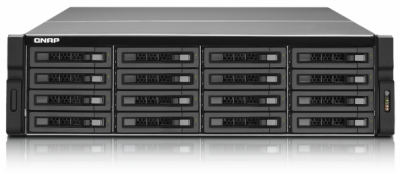
The new models can simultaneously provide storage solutions for IP-SAN (iSCSI) and NAS implementations and are VMware® Ready™, Citrix® Ready™, and Windows® Hyper-V™ compliant, making them ideal for providing network shared storage for virtual server environments. These two new models are designed with cable-less backplanes connecting drives to the controller board seamlessly, significantly reducing failure points. The hot-swappable fan module and cooling ducting/heat exchange simplify data center installations. Hardware security is enhanced with intrusion detection, which generates a log entry and alerts the administrators when the chassis is opened.


