
ADATA Launches XPG SX8200 PCIe Gen3x4 NVMe 1.3 SSD
ADATA Technology, a leading manufacturer of high performance DRAM modules and NAND Flash products, today launched the XPG SX8200, its fastest consumer SSD to date. It arrives in a compact M.2 2280 form factor and uses the ultra-fast PCIe3x4 interface to deliver up to 3200MB/s read and 1700MB/s write – which is perfect for gamers, overclockers, and PC DIY enthusiasts in pursuit of unsurpassed performance! SX8200 employs the latest 2nd generation 64-layer 3D NAND Flash for improved reliability and ships in capacities of 240GB, 480GB, and 960GB.

PCIe Gen3x4 - Breakthrough the Barrier of Speed
Leveraging ultra-fast PCIe Gen3x4 interface and the NVMe 1.3 protocol, the SX8200 provides tremendous improvement in read/write performance. It implements a 32bit DRAM data bus, intelligent SLC Caching, and a DRAM cache buffer, accelerating sequential and 4K random read/write speeds. It reaches speeds of up to 3200MB/s for reads and 1700MB/s for writes and 310K/280K IOPS random 4K read/writes for faster boot, shorter game loads, and system response time.
 LITE-ON Storage, an established leader in the rapidly expanding solid-state drive (SSD) industry, said today it will demonstrate its latest enterprise drives, the NVRAM Hybrid SSD, during the OCP U.S. Summit 2018, kicking off here today.
 Samsung Electronics Co., Ltd., the world leader in advanced memory technology, today announced that it is rolling out its PM883, the highest density datacenter SATA drive, at eight terabytes (TB). Samsung’s new solid state drive (SSD) offering is the industry’s first datacenter SATA drive to incorporate LPDDR4 DRAM modules and features a 6.0-gigabits-per-second (Gbps) 2.5-inch SATA interface.
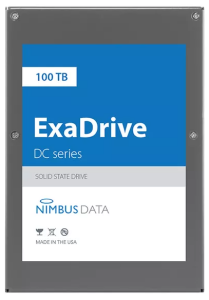 Nimbus Data, a pioneer in flash memory solutions, today announced the ExaDrive DC100, the largest capacity (100 terabytes) solid state drive (SSD) ever produced. Featuring more than 3x the capacity of the closest competitor, the ExaDrive DC100 also draws 85% less power per terabyte (TB). These innovations reduce total cost of ownership per terabyte by 42% compared to competing enterprise SSDs, helping accelerate flash memory adoption in both cloud infrastructure and edge computing.