
Toshiba Announces Video Speed Class 30 EXCERIA microSDXC Cards
Toshiba Memory Europe GmbH has announced three new additions to the EXCERIA family of microSDXC cards, named M303. With capacities of up to 256GB, maximum read/write speeds of 98MB/s and 65MB/s respectively, as well as a new Video Speed Class 30 (V30), the M303 allows users to record and store 4K Ultra HD content.
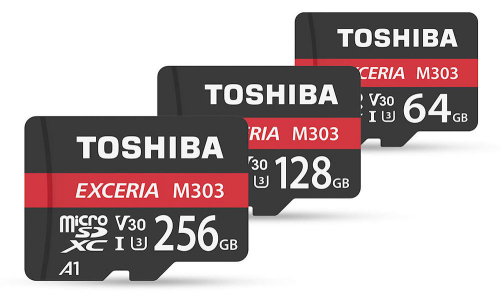
The M303's speed rating supports 4K Ultra HD video recording; a prerequisite for the latest action cameras, video recorders and drones. Smartphones compatible with microSDXC specification will benefit from the M303's ability to write high-resolution videos and images at high speed. Rated with Video Speed Class 30 (V30), the M303 provides a minimum data transfer rate of 30 MB/s with a recommended UHS device under the conditions regulated by SD association.
Add a comment As mobile content and applications grow increasingly sophisticated, Western Digital Corporation is transforming the mobile experience with new industry-leading mobile solutions designed to enable consumers to better capture, share and enjoy rich content on their devices. At Mobile World Congress, the company is releasing the world’s fastest UHS-I flash memory card, the 400GB SanDisk Extreme UHS-I microSDXC card, and demonstrating the future of flash memory card technology with Peripheral Component Interconnect Express (PCIe)-enabled cards, designed to deliver the performance required for the next wave of data and content-intensive applications.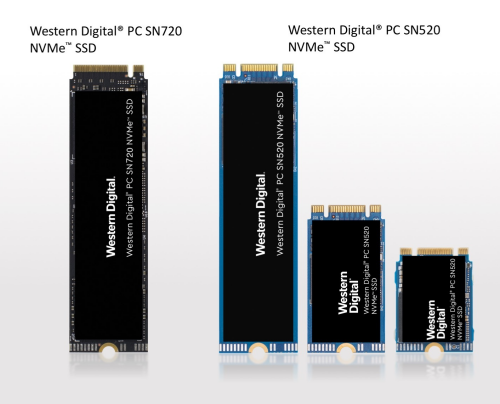
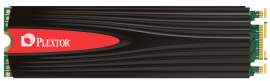 CDRLabs has taken an in depth look Plextor's latest PCIe SSD, the M9Pe. Optimized for high-level PC gaming, this M.2 form factor drive is powered by Marvell's 88SS1093 "Eldora" controller and is available with up to 1TB of Toshiba's 64-layer BiCS3 3D TLC NAND flash. To compensate for the slow write speeds typically associated with TLC NAND, the M9Pe uses Plextor's exclusive PlexNitro cache acceleration technology to optimize performance without taking up any space on the drive. The M9P is also equipped with a PCIe Gen3 x4 NVMe 1.2 interface to provide higher bandwidth and lower latency than SATA SSDs.