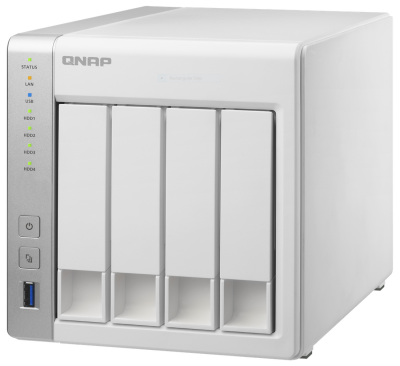

QNAP Releases QTS 4.1.2 With NAS Installation Over HDMI And Google Chromecast Streaming
QNAP Systems, Inc. today released the Turbo NAS QTS 4.1.2 operating system, introducing NAS Installation over HDMI - a pioneering function in the NAS market that allows installing a NAS without a network connection, and adds several new features including VPN Server support, VPN Client support, block-based LUN backup, subtitle (*.SRT) support for Video Station and File Station, embedding subtitles into transcoded videos, Chromecast streaming, and more.

“We have made many enhancements to the business and home features in QTS 4.1.2 to provide a better user experience and to make the Turbo NAS a great companion in the workplace and for home entertainment,” said Willy Kuo, product manager of QNAP.
QNAP is the first NAS provider to provide NAS installation over HDMI. Users can now enjoy extreme convenience by setting up their Turbo NAS locally without a network connection: just connect a keyboard, mouse and HDMI monitor to the Turbo NAS, and the NAS installation process can be completed effortlessly. “NAS installation over HDMI is a breakthrough innovation that eliminates many difficulties that users may encounter when initially setting up their NAS. No complicated procedures are necessary, no network expertise is required, and it helps users to quickly finish installing their NAS just like operating a PC,” added Kuo.
Add a comment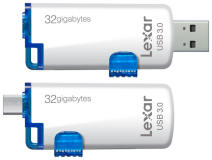 Today, CDRLabs brings you a review of Lexar's new 2-in-1 USB flash drive, the JumpDrive M20 Mobile. Designed for use with On-The-Go (OTG)-enabled Android tablets and smartphones, the M20 Mobile sports a thumb slide design with a connector on each end - micro-USB and USB 3.0 - that both retract. With these two connectors, users can transfer playlists, photos, videos and files between their OTG-enabled Android devices, or from device to computer, without the use of cables or Wi-Fi. The M20 Mobile also leverages USB 3.0 performance, offering read speeds of up to 120MB/s. At these speeds, you can transfer a 3GB HD video clip in less than one minute, compared to the 4 minutes it takes using a standard USB 2.0 drive.