

Kioxia Introduces Automotive UFS Ver. 4.0 Embedded Flash Memory
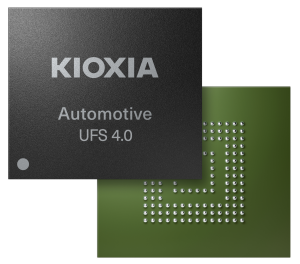 Kioxia Corporation, a world leader in memory solutions, today announced sampling of the industry’s first Universal Flash Storage (UFS) Ver. 4.0 embedded flash memory devices designed for automotive applications. These new, higher performing devices deliver fast embedded storage transfer speeds in a small package size and are targeted to a variety of next-generation automotive applications, including telematics, infotainment systems and ADAS. The improved performance of UFS products from Kioxia – including approximately +100% for sequential read speed and approximately +40% for sequential write speed – enables these applications to take advantage of 5G’s connectivity benefits, leading to faster system startup times and a better user experience.
The first to introduce UFS technology, Kioxia continues to move the technology forward. Its new UFS Ver. 4.0 devices integrate the company’s innovative BiCS FLASH™ 3D flash memory and a controller in a JEDEC-standard package. UFS 4.0 incorporates MIPI M-PHY 5.0 and UniPro 2.0 and supports theoretical interface speeds of up to 23.2 gigabits per second (Gbp/s) per lane or 46.4 Gbp/s per device. UFS 4.0 is backward compatible with UFS 3.1.
Add a comment
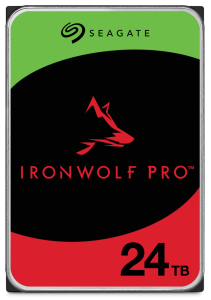 Today, Seagate Technology Holdings plc, a world leader in mass-data storage infrastructure solutions, launched the new Seagate IronWolf Pro 24TB hard drive addresses the evolving data demands of SMB and enterprise network attached storage (NAS) environments.
 CDRLabs kicks off the week with a review of ADATA's external USB4 SSD, the SE920. Available in 1TB and 2TB capacities, this new drive is equipped with a USB4 Type-C interface. With a transfer speed of 40Gbs, the SE920 is twice as fast as drives using USB 3.2 Gen2 x2 and is capable of delivering up to 3,800 MB/s read and 3,700 MB/s write speeds, allowing it to transfer a 10GB 4K high definition video in as little as 3 seconds. The SE920 also features a unique heat dissipation system with a built-in micro fan. With the case extended and the fan enabled, the drive is 10% cooler than fanless products of the same specifications.


