

TRIM Performance:
While SSD's offer many benefits, there are some downsides to using flash memory. One of the biggest issues people run into is performance degradation. Over time, an SSD will run out of fresh blocks and will have to write over data the file system has marked as deleted. This procedure is very complicated and can slow an SSD's write speeds considerably.
To fix this problem, most manufacturers have added TRIM support to their SSDs. The TRIM command allows an operating system, such as Windows 7, to tell an SSD which data blocks are no longer in use. Using this information, the drive pro-actively erases these blocks and adds them to the free block pool.
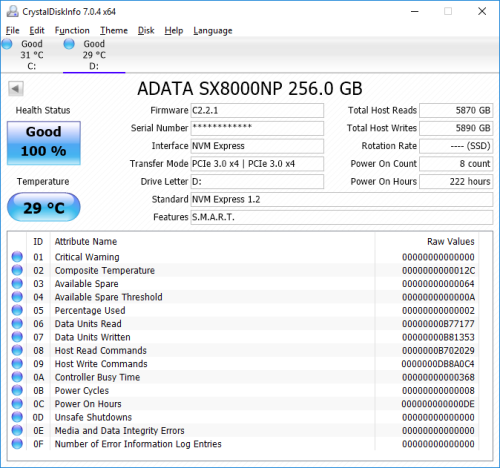
To test the SX8000's TRIM and garbage collection functions, I first put the drive in a "dirty" state. I used Iometer to fill the entire drive and then ran a random write test for 30 minutes. Looking at the screenshot below, you can see that the SX8000's average read and write speeds dropped to 212.7 MB/s and 158.5 MB/s, respectively.
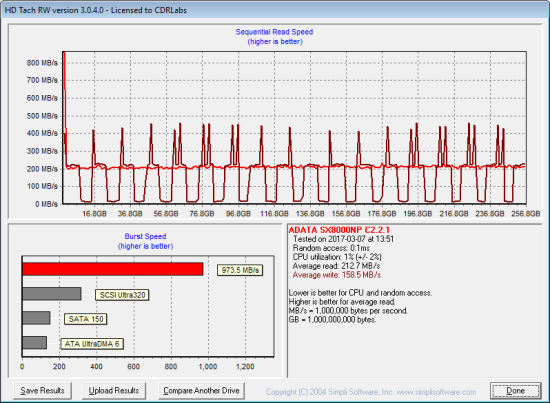
ADATA XPG SX8000 - Dirty
To see how well the SX8000 could recover, I let the computer sit for about 30 minutes and then reran the test. The drive's average read speed climbed up to 277.1 MB/s. However, its write speed lagged behind, averaging out at only 222.4 MB/s.

ADATA XPG SX8000 - After TRIM
Lastly, I used Parted Magic to perform a secure erase on the SX8000. With the drive wiped clean, it had average read and write speeds of 858.7 MB/s and 780.1 MB/s, respectively.
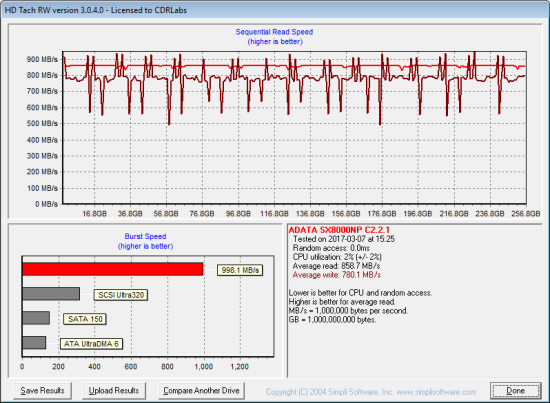
ADATA XPG SX8000 - Secure Erased
Final Thoughts:
ADATA's XPG SX8000 is a great choice for the budget-conscious gamer looking to put an NVMe SSD in their notebook or desktop computer. This compact, M.2 form factor SSD is powered by Silicon Motion's SM2260 controller and is available with up to 1TB of 3D MLC NAND flash. The SX8000 is also equipped with an NVMe 1.2 certified, PCIe Gen3 x4 interface capable of delivering nearly four times the performance of your average SATA 6Gb/s SSD. In our sequential read and write tests, the 256GB version of the drive was able to read at speeds as high as 2,096 MB/s and write at speeds in excess of 1,105 MB/s. The SX8000 also did quite well in our random write tests, producing more than 173,000 IOPS at low queue depths.
Of course, fast read and write speeds aren't the only things the XPG SX8000 has to offer. In addition to a large DRAM cache buffer, the drive uses an intelligent SLC caching algorithm to boost read and write performance. The SX8000 also features advanced LDPC error correction, Data Shaping, and a RAID Engine to ensure data integrity and extend the lifespan of the SSD. To top it all off, the drive is backed by a 5 year warranty.
The XPG SX8000 is available now in 128GB, 256GB and 512GB capacities. Prices on Amazon.com currently range from $90 up to $250, with the 256GB version reviewed here retailing for about $105. The 1TB model has not shipped yet but is expected to hit retailers later this year.

Highs:
- PCIe 3.0 x4 interface with NVMe protocol
- Available in 128GB, 256GB, 512GB and 1TB capacities
- Micron 3D MLC NAND
- Good sequential and random read and write performance
- RAID Engine, Data Shaping and LDPC ECC technologies
- Small M.2 2280 form factor
- Intelligent SLC caching
- Large DRAM cache
- Reasonably priced
- 5 year warranty
Lows:
- Write speed drops considerably when SLC cache is full
- Does not support hardware based encryption


