

TRIM Performance:
While SSD's offer many benefits, there are some downsides to using flash memory. One of the biggest issues people run into is performance degradation. Over time, an SSD will run out of fresh blocks and will have to write over data the file system has marked as deleted. This procedure is very complicated and can slow an SSD's write speeds considerably.
To fix this problem, most manufacturers have added TRIM support to their SSDs. The TRIM command allows an operating system, such as Windows 10, to tell an SSD which data blocks are no longer in use. Using this information, the drive pro-actively erases these blocks and adds them to the free block pool.

To test the P2's TRIM and garbage collection functions, I first put the drive in a "dirty" state. I used Iometer to fill 80% of the drive and then ran a random write test for 30 minutes. This had little impact on the P2's read speed. However, its average writing speed dropped to 112.99 MB/s.
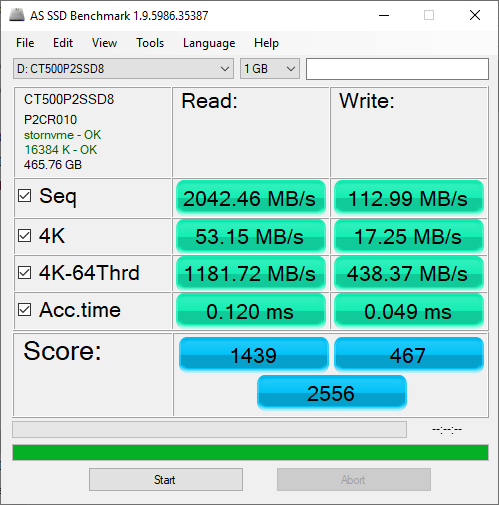
Crucial P2 - Dirty
To see how well the P2 could recover, I let the computer sit for about 30 minutes and then reran the test. The drive's sequential write speed climbed up to 646.34 MB/s. However, its read speed dropped down to 1287.21 MB/s while it was recovering.

Crucial P2 - After TRIM
Lastly, I used Parted Magic to perform a secure erase on the P2. With the drive wiped clean, it had average read and write speeds of 2088.88 MB/s and 1125.18 MB/s, respectively.
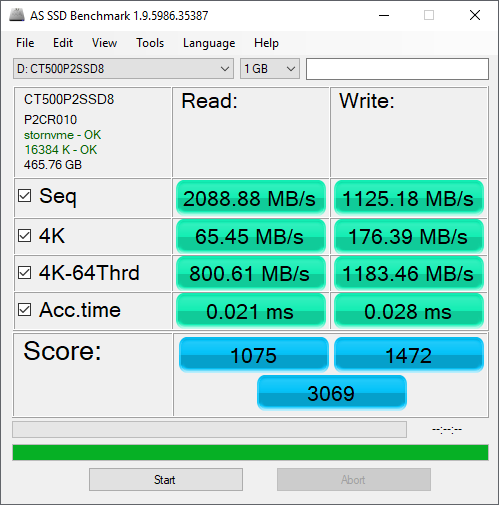
Crucial P2 - Secure Erased
Final Thoughts:
Crucial's P2 SSD is a good choice for the value-conscious consumer looking to boost the performance and storage capacity of their desktop or notebook computer. This compact, M.2 form factor SSD is powered by Phison's PS5013-E13T controller and is available with up to 2TB of Micron's 3D TLC NAND flash. Combine this with a PCIe Gen3 x4 NVMe 1.3 interface and you have a drive capable of delivering performance well beyond that of your average SATA SSD at nearly the same price.
The P2's performance varied a lot depending on the benchmark and the type of data used. With highly compressible data, the drive was able to read and write at speeds in excess of 3,200 MB/s. These numbers dropped considerably when working with incompressible data. However, the P2 still performed better than expected, reaching, in some cases, nearly twice its rated write speed. The only real disappointment came with PCMark where the P2 lagged behind other, similarly priced, PCIe SSDs.
Despite being budget friendly, the P2 includes many of the same features found on Crucial's higher-end SSDs. The drive uses technologies like Dynamic Write Acceleration to optimize performance as well as multistep data integrity algorithms and Redundant Array of Independent NAND (RAIN) to protect data and prevent it from becoming corrupted. The P2 also features thermal and power loss protection, active garbage collection and NVMe Autonomous Power State Transition (APST) support. To top it all off, it comes with Acronis True Image cloning software and is covered by a generous 5 year warranty.
The Crucial P2 is available now in 250GB, 500GB, 1TB and 2TB capacities. Prices on Amazon.com currently range from $50 up to $225, with the 500GB version reviewed here retailing for about $60.

Highs:
- Available in 250GB, 500GB, 1TB and 2TB capacities
- PCIe 3.0 x4 interface with NVMe protocol
- Phison PS5013-E13T controller
- Equipped with Micron 3D TLC NAND
- Good sequential and random read and write speeds under most conditions
- Good random read and write performance
- Small M.2 2280 form factor
- Dynamic Write Acceleration
- Supports Redundant Array of Independent NAND and Multistep Data Integrity Algorithms
- Supports TRIM and active garbage collection
- Thermal and power loss protection
- Includes Acronis True Image cloning software
- 5 year warranty
Lows:
- Not as fast when reading and writing incompressible data
- Does not support hardware based encryption


