

TRIM Performance:
While SSD's offer many benefits, there are some downsides to using flash memory. One of the biggest issues people run into is performance degradation. Over time, an SSD will run out of fresh blocks and will have to write over data the file system has marked as deleted. This procedure is very complicated and can slow an SSD's write speeds considerably.
To fix this problem, most manufacturers have added TRIM support to their SSDs. The TRIM command allows an operating system, such as Windows 7, to tell an SSD which data blocks are no longer in use. Using this information, the drive pro-actively erases these blocks and adds them to the free block pool.

To test the Trion 100's TRIM and garbage collection functions, I first put the drive in a "dirty" state. I used Iometer to fill the entire drive and then ran a random write test for 30 minutes. Looking at the screenshot below, you can see that the Trion 100's average read and write speeds dropped to 212.8 MB/s and 225.9 MB/s, respectively.
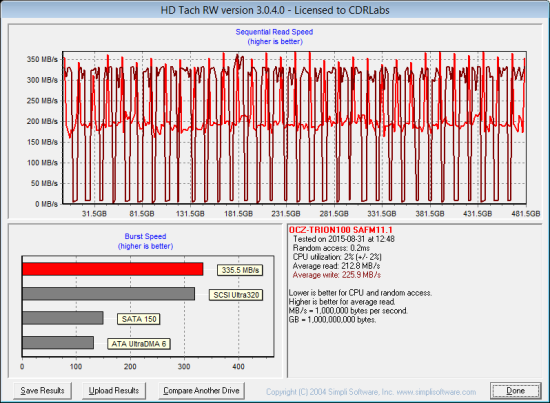
OCZ Trion 100 - Dirty
I let the computer sit for about an hour and then reran the test. The drive's average write speed jumped up to 287.6 MB/s. However, its read speed lagged a bit behind, averaging out at 222.3 MB/s.
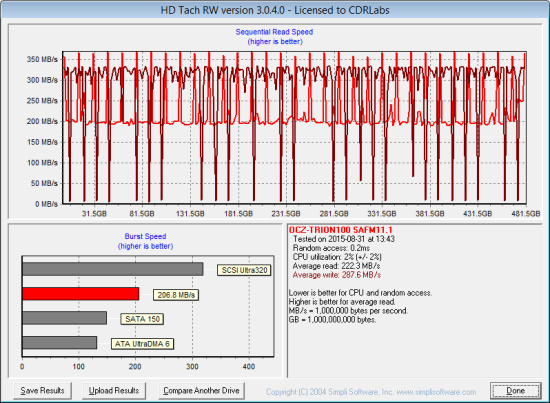
OCZ Trion 100 - After TRIM
Lastly, I used OCZ's SSD Guru software to perform a secure erase on the Trion 100. With the drive wiped clean, it had average read and write speeds of 359.5 MB/s and 299.9 MB/s, respectively.
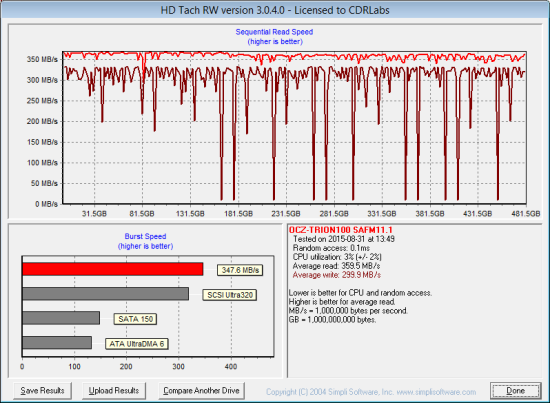
OCZ Trion 100 - Secure Erased
Final Thoughts:
While not the fastest or most feature packed SSD to come through the 'Labs, OCZ's Trion 100 delivers a lot of bang for your buck. Powered by Toshiba's new TC58 controller, the Trion 100 uses A19nm TLC NAND to provide an easy and affordable way for consumers to improve the performance of their mobile or desktop systems. In our sequential read and write tests, the 480GB version of the drive was able to read at speeds as high as 564 MB/s and write at speeds in excess of 489 MB/s. It also had no problems holding its own when doing random reads, but lagged behind other drives in our random write tests, producing a little more than 30,000 IOPS at low queue depths.
Like most TLC-based SSDs, the Trion 100 does have its limitations. To compensate for the slow write speeds typically associated with this type of NAND, the drive employs a form of SLC caching. Using this cache, the drive is able to maintain peak performance under normal workloads. However, once a consecutive write operation exceeds the size of the cache and you make the transition to TLC NAND, the Trion 100's write speed drops considerably. It's unlikely that you will ever run into this situation if your computer is used primarily for web browsing or word processing, but, if you have heavier workloads, you may want to consider one of OCZ's other drives.
The Trion 100 is available now in 120GB, 240GB, 480GB and 960GB capacities. Prices on Amazon currently range from $51 up to $280, with the 480GB version reviewed here going for about $160.
Highs:
- Available in 120GB, 240GB, 480GB and 960GB capacities
- Good sequential read and write speeds under most conditions
- Performs equally well with compressible and incompressible data
- SATA 6Gb/s interface
- Supports TRIM and idle background garbage collection
- Ultra-slim form factor
- Works with OCZ's SSD Guru software
- Supports DEVSLP
- Reasonably priced
- 3 year ShieldPlus warranty
Lows:
- Mediocre random write performance
- Write speed drops when SLC cache is full
- Does not support hardware based encryption


