

TRIM Performance:
While SSD's offer many benefits, there are some downsides to using flash memory. One of the biggest issues people run into is performance degradation. Over time, an SSD will run out of fresh blocks and will have to write over data the file system has marked as deleted. This procedure is very complicated and can slow an SSD's write speeds considerably.
To fix this problem, most manufacturers have added TRIM support to their SSDs. The TRIM command allows an operating system, such as Windows 7, to tell an SSD which data blocks are no longer in use. Using this information, the drive pro-actively erases these blocks and adds them to the free block pool.

To test the S2C's TRIM and garbage collection functions, I first put the drive in a "dirty" state. I used Iometer to fill the entire drive and then ran a random write test for 30 minutes. This had little impact on the S2C's read speed. However, its average writing speed dropped to a mere 42.8 MB/s.

Plextor S2C - Dirty
To see how well the S2C could recover, I let the computer sit for about 30 minutes and then reran the test. The drive wasn't able to reach the factory fresh performance shown in our earlier tests. However, its average write speed climbed up to 182.8 MB/s.

Plextor S2C - After TRIM
Lastly, I used Plextor's Plextool software to perform a secure format on the S2C. With the drive wiped clean, it had average read and write speeds of 454.7 MB/s and 222.7 MB/s, respectively.
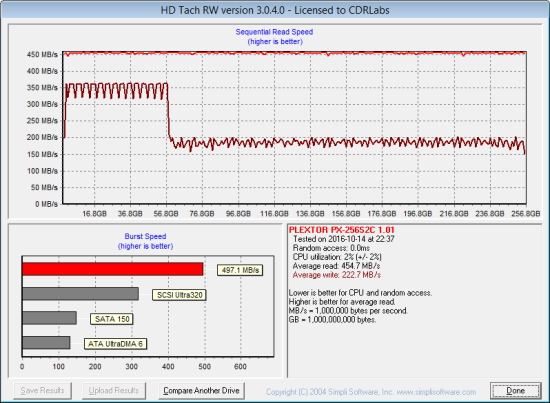
Plextor S2C - Secure Erased
Final Thoughts:
Plextor's S2C SSD is a great choice for the consumer looking for an easy and affordable way to improve the performance of their existing computer. This entry-level drive combines SMI's SM2258 controller with SK Hynix's 16nm TLC NAND to deliver good performance and innovative features at a price that won't break the bank. Thanks to Plextor's PlexNitro technology, the S2C performed relatively well throughout most of our tests. In our sequential read and write tests, the 256GB version of the drive was able to read at speeds as high as 564MB/s and write at speeds in excess of 528 MB/s. It also had no problems holding its own against other TLC-based SSDs in our random write tests, producing more than 53,000 IOPS at low queue depths.
While Plextor's PlexNitro technology works well under normal workloads, it does have its limitations. If you have a heavy workload, where a consecutive write operation exceeds the size of the SLC cache, the S2C's write speed drops to non-accelerated levels. Thankfully, this drop in performance isn't nearly as dramatic as what we've seen with other TLC-based SSDs. With its ability to bypass the cache and write directly to the TLC NAND, the S2C outperformed many of the TLC-based drives we've tested, including the M7V, when doing sustained sequential writes.
Of course, fast read and write speeds aren't the only things the S2C has to offer. The drive is compatible with Plextor's Plextool software and supports their PlexTurbo smart cache technology. The S2C is also compatible with PlexVault and PlexCompressor software, which have traditionally been reserved for the company's higher end drives. That being said, the S2C does not support Device Sleep (DEVSLP) or hardware based encryption. This probably isn't an issue if you're looking for an SSD for your desktop computer. However, these are things you may want to keep in mind if the S2C is going in a laptop or if data security is a concern.
The S2C will be shipping soon in 128GB, 256GB and 512GB capacities. Suggested retail prices range from $46 to $134, with the 256GB version reviewed here going for about $76.

Highs:
- Available in 128GB, 256GB and 512GB capacities
- SMI SM2258 controller
- SK Hynix 16nm TLC NAND flash
- Good sequential read and write speeds under most conditions
- PlexNitro technology optimizes performance without taking up SSD space
- Supports PlexTurbo, PlexVault and PlexCompressor technologies
- Direct-to-die write method for optimal sustained write performance
- Large DRAM cache
- Ultra-slim form factor
- 3 year warranty
- Affordably priced
Lows:
- Write speed drops when SLC cache is full
- SLC cache is small
- Does not support DEVSLP
- Does not support hardware based encryption
- Endurance rating is lower than M7V


