

TRIM Performance:
While SSDs offer many benefits, there are some downsides to using flash memory. One of the biggest issues people run into is performance degradation. Over time, an SSD will run out of fresh blocks and will have to write over data the file system has marked as deleted. This procedure is very complicated and can slow an SSD's write speeds considerably.
To address this problem, most manufacturers have added TRIM support to their SSDs. The TRIM command allows an operating system, such as Windows 7, to tell an SSD which data blocks are no longer in use. Using this information, the drive pro-actively erases these blocks and adds them to the free block pool.
To test the 850 EVO's TRIM and garbage collection functions, I first put the drive in a "dirty" state. I used Iometer to fill the entire drive and then ran a random write test for 30 minutes. This had little impact on the 850 EVO's read speed. However, its average writing speed dropped to a mere 49.1 MB/s.
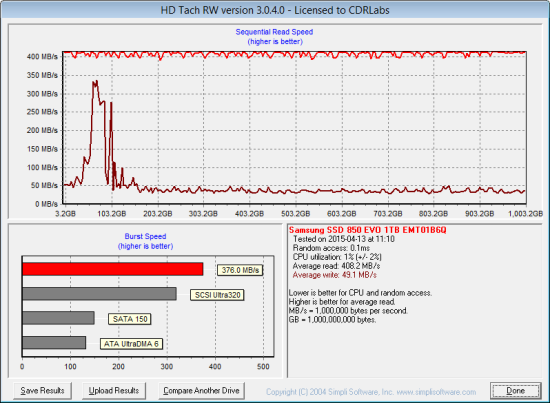
Samsung SSD 850 EVO - Dirty
To see how well the 850 EVO could recover, I let the computer sit for about an hour and a half and then reran the test. Looking at the screenshot below, you can see that the drive's average writing speed jumped back up to 329.9 MB/s.
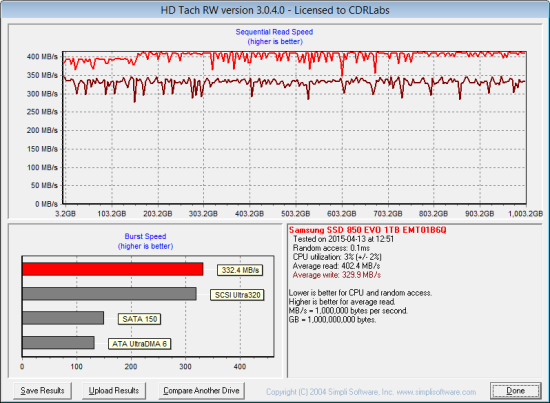
Samsung SSD 850 EVO - After Trim
Lastly, I used Samsung's SSD Magician software to perform a secure erase of the 850 EVO. With the drive wiped clean, it had average read and write speeds of 406.4 MB/s and 330.3 MB/s, respectively.
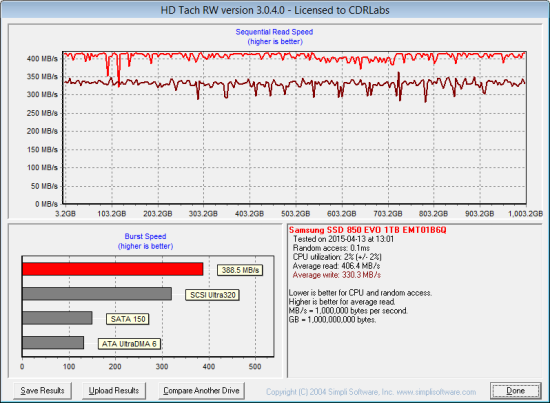
Samsung SSD 850 EVO - Secure Erase
Final Thoughts:
Over the last few months, we've taken a look at a number of Samsung's 850 EVO series SSDs. Available in a variety of form factors and capacities, these drives offer a lot of bang for your buck. The 1TB version of the 2.5-inch 850 EVO is no exception. Powered by the same 3-core MEX controller found in the 850 PRO, this high-capacity drive uses Samsung's 3-bit 3D V-NAND flash to deliver a fast and responsive computing experience at a reasonable price. In our sequential read and write tests, the 1TB 850 EVO was able to read at speeds as high as 560 MB/s and write at speeds in excess of 510 MB/s. The drive also did very well in our random write tests, producing more than 89,000 IOPS at low queue depths.
The 1TB 850 EVO performed even better when Samsung's RAPID technology was enabled. The results varied a lot from one benchmark to another, but even on the low end the drive's sequential read and write speeds increased by 63 MB/s. RAPID mode also had a big impact on the drive's random write performance. When tested with Iometer, the 850 EVO's random write speed increased by more than 47 MB/s, giving it the ability to deliver more than 101,000 IOPS at low queue depths.
Fast read and write speeds aren't the only things the 850 EVO has to offer. Along with support for technologies like RAPID and TurboWrite, the drive features AES 256-bit full disk encryption and is compatible with both the TCG Opal and IEEE 1667 specifications. The 850 PRO also supports the SATA Device Sleep (DEVSLP) standard which extends the battery life of a device by reducing the drive's power consumption when it's not in use. To top it all off, the 850 EVO is covered by a generous 5 year warranty.
The 2.5-inch 850 EVO is available now in 120GB, 250GB, 500GB and 1TB capacities. Prices on Amazon.com currently range from $75 up to $399 for the 1TB version reviewed here.

Highs:
- Equipped with 3-bit 3D V-NAND
- Available in 120GB, 250GB, 500GB and 1TB capacities
- Features RAPID mode and TurboWrite technology
- Excellent sequential read and write speeds
- Very good random read and write performance
- Performs equally well with compressible and incompressible data
- Good looking, ultra-slim design
- SATA 6Gb/s interface
- Large SDRAM cache
- Supports TRIM, garbage collection and wear leveling
- AES 256-bit full disk encryption
- TCG Opal and IEEE 1667 compliant
- Includes SSD Magician software and Data Migration Tool
- Reasonably priced
- 5 year warranty
Lows:
- RAPID mode is Windows only
- 1TB drive uses more power than other capacities


